
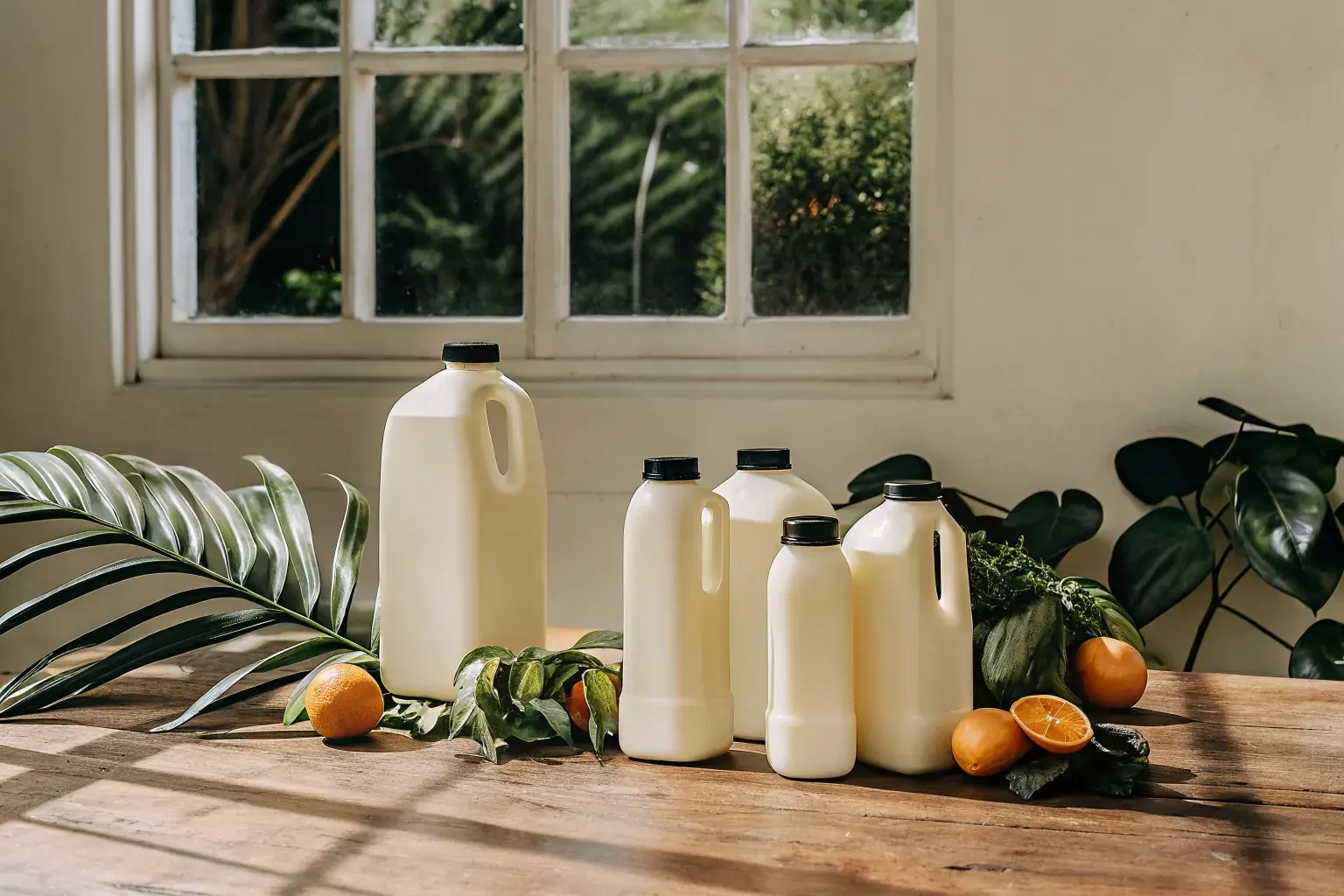
Over one billion HDPE milk and juice jugs are discarded in the United States every single year. Despite being technically recyclable, fewer than 30% ever make it through a recycling loop — milk residue contaminates loads, and most consumers never rinse them properly before disposal. The rest spend the next 500 years in a landfill, slowly fragmenting into the microplastics that now appear in the food we grow, the water we drink, and the bodies of the animals we raise. PHA milk and juice jugs offer the dairy and beverage industry its first genuine material-level exit from this cycle.
Polyhydroxyalkanoates — PHA — are biopolymers produced by bacteria fermenting plant-based oils such as canola. When applied to jug manufacturing, the result is a gallon or half-gallon container that performs identically to HDPE under refrigeration and ambient conditions, while leaving no permanent trace in the environment when its useful life is over. No microplastics. No petroleum. No 500-year liability on the planet's balance sheet.
The Scale of the HDPE Milk & Juice Jug Problem
The average American household buys more than 100 gallons of milk and juice in a given year — and each gallon or half-gallon arrives in an HDPE plastic jug that will outlast its contents by approximately 499 years and 364 days. Multiply that across the U.S. population, and the result is more than one billion HDPE jugs entering the waste stream annually. The recycling system was never designed to absorb that volume, and dairy jugs present a specific contamination challenge that makes the math worse: milk fat and protein residue disqualifies contaminated loads from standard recycling processing, so even consumers who sort correctly often send their jug to landfill.
In a landfill, a conventional HDPE milk jug does not disappear. It fragments. Ultraviolet light and physical stress break it into progressively smaller plastic particles — microplastics — that migrate into groundwater, soil ecosystems, and the bodies of every organism living within them. The dairy and juice industries have, for decades, benefited from a packaging material that is extraordinarily durable but extraordinarily persistent. PHA changes that equation without changing the container.
1 Billion+ HDPE jugs discarded yearly
More than one billion HDPE milk and juice jugs are thrown away annually in the U.S. — the vast majority ending up in landfills rather than recycling facilities.
500+ years to fragment
A conventional HDPE milk jug takes over 500 years to break apart — and even then it only fragments into microplastics, never fully disappearing from the environment.
Less than 30% actually recycled
Milk and juice residue contaminates recycling loads, meaning fewer than 30% of HDPE jugs actually complete a recycling loop despite being theoretically recyclable.
What Makes PHA Different from HDPE
PHA is not a petroleum plastic with a green label — it is a biopolymer built from scratch by living bacteria. When fed plant-based oils or organic carbon sources, certain bacterial strains accumulate PHA granules inside their cells as stored energy. These granules are harvested, refined into food-safe resin pellets, and processed through standard extrusion blow molding equipment — the same machinery used to produce HDPE jugs — to create containers that match HDPE's dimensional specifications exactly.
What fundamentally separates PHA from every other alternative packaging material is what happens at end of life. PLA bioplastic requires industrial composting at controlled high temperatures to degrade. Conventional plastic requires 500+ years and still never fully disappears. PHA requires neither. In soil, freshwater, and marine environments, naturally occurring bacteria recognize PHA as a carbon energy source and metabolize it completely — leaving water, CO₂, and organic biomass as byproducts. No microplastics. No toxic residue. No persistence.
For dairy and juice jug manufacturers specifically, PHA represents the first biodegradable option that does not require consumers to change their behavior. A PHA jug that ends up in a landfill will biodegrade. One that enters a waterway will not persist for centuries. One composted at home or industrially will fully break down. The environmental outcome improves regardless of where the container ends up — and that is what makes the transition genuinely transformative.
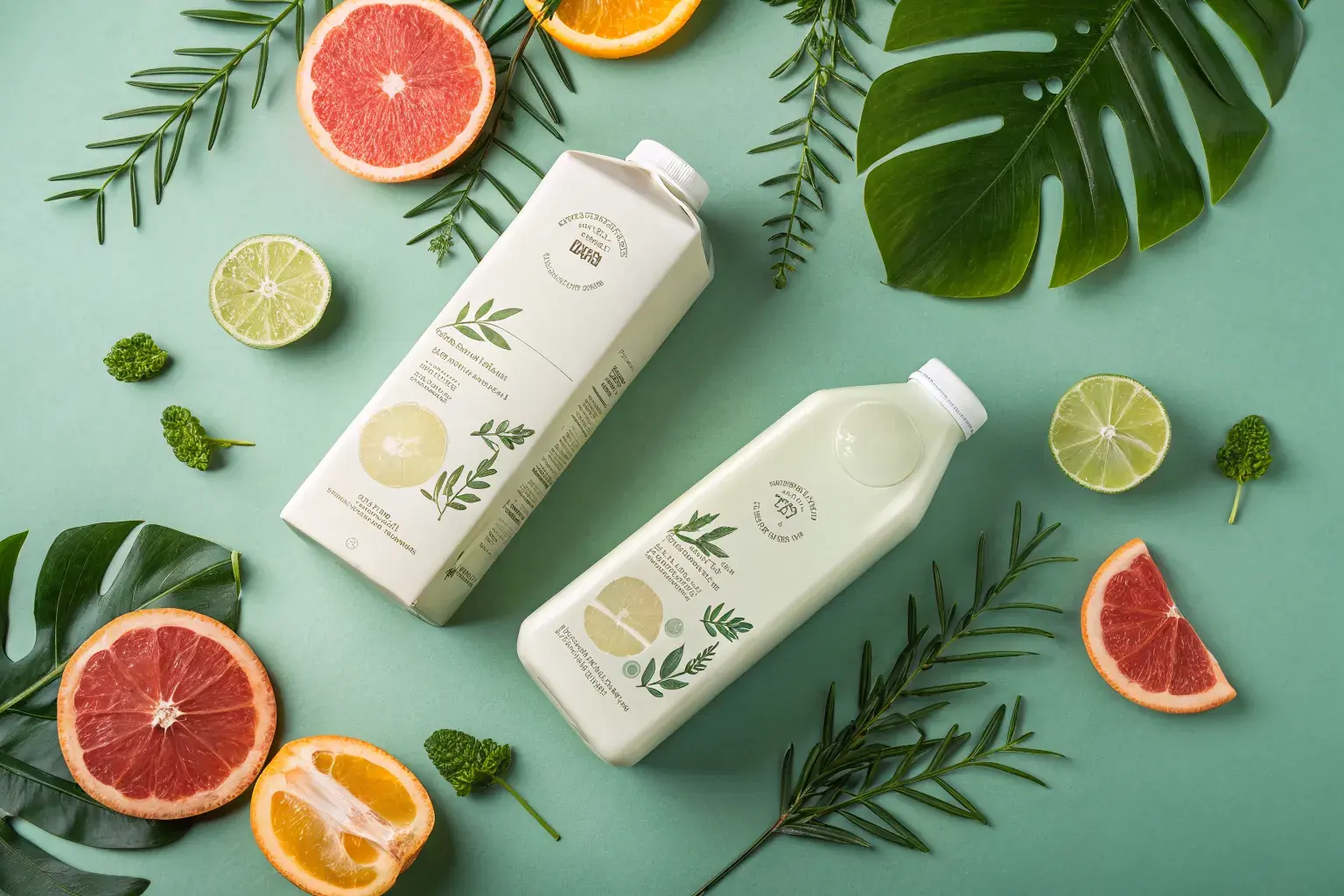
Seven Advantages of PHA Milk & Juice Jugs
PHA milk and juice jugs are not just an environmentally responsible alternative — they are a technically complete replacement for HDPE across every performance dimension that matters to dairy brands, juice producers, retailers, and consumers. Here is what makes them the superior choice.
- 01
Complete Biodegradability Across All Real-World Environments
PHA biodegrades in soil, freshwater, marine environments, home compost, and industrial composting facilities — without requiring specialized disposal infrastructure. Unlike PLA, which only breaks down efficiently in industrial composting conditions, PHA completes its biodegradation cycle wherever naturally occurring bacteria are present. A PHA jug that ends up in a landfill will biodegrade. One that enters the ocean will not persist for 500 years.
- 02
Zero Microplastic Generation at Any Stage
Conventional HDPE jugs fragment under physical stress and UV exposure, releasing microplastic particles into soil and water systems at every stage of degradation. PHA does not fragment — it is enzymatically metabolized by bacteria that consume and break down the biopolymer completely. The degradation byproducts are water, CO₂, and organic biomass. There is no microplastic residue at any point in the process.
- 03
100% Petroleum-Free Manufacturing
PHA is synthesized from renewable plant-based feedstocks including canola oil and sugarcane-derived carbon sources — no fossil fuels required from raw material to finished jug. This eliminates the carbon debt that HDPE carries from petroleum extraction through refining and manufacturing. For dairy brands and juice producers with sustainability commitments and supply chain transparency requirements, PHA provides a verifiable, material-level credential that offsets cannot replicate.
- 04
Drop-In Manufacturing Compatibility — No Retooling Required
PHA milk and juice jugs are engineered to match standard HDPE jug dimensions precisely — same handle geometry, same cap thread specifications, same shelf footprint. They are compatible with existing extrusion blow molding equipment, filling lines, capping systems, and retail shelf configurations. Dairy and juice brands adopting PHA do not need to retool equipment, reconfigure production lines, or change supplier packaging relationships. The transition is a material swap, not an operational overhaul.
- 05
Refrigeration-Stable and Barrier-Tested
PHA maintains structural integrity under refrigeration and ambient storage conditions. Our jug formulations include engineered oxygen and moisture barrier properties that protect dairy and juice product shelf life on par with conventional HDPE packaging. Temperature cycling, cold chain distribution, and standard retail refrigeration environments do not compromise jug performance — the switch to PHA is not a functional compromise.
- 06
BPA-Free and Phthalate-Free by Nature
Because PHA is produced biologically without synthetic plasticizers, chemical stabilizers, or petroleum-derived additives, it contains none of the endocrine-disrupting compounds associated with conventional plastics. No BPA. No phthalates. No chemical migration into refrigerated dairy or juice products. This is especially relevant for brands serving families with young children, where plastic chemical exposure is a documented consumer concern.
- 07
Regulatory Future-Proofing for Extended Producer Responsibility
Single-use plastic regulations are expanding globally. Extended producer responsibility (EPR) frameworks in the European Union, U.S. states, and international markets are increasingly placing the cost of plastic waste management on the producers and distributors of that waste. PHA qualifies for the most stringent biodegradability certifications available — including marine biodegradation standards — that conventional HDPE and most other bioplastics cannot achieve. Brands transitioning to PHA jugs now position themselves ahead of compliance requirements rather than behind them.
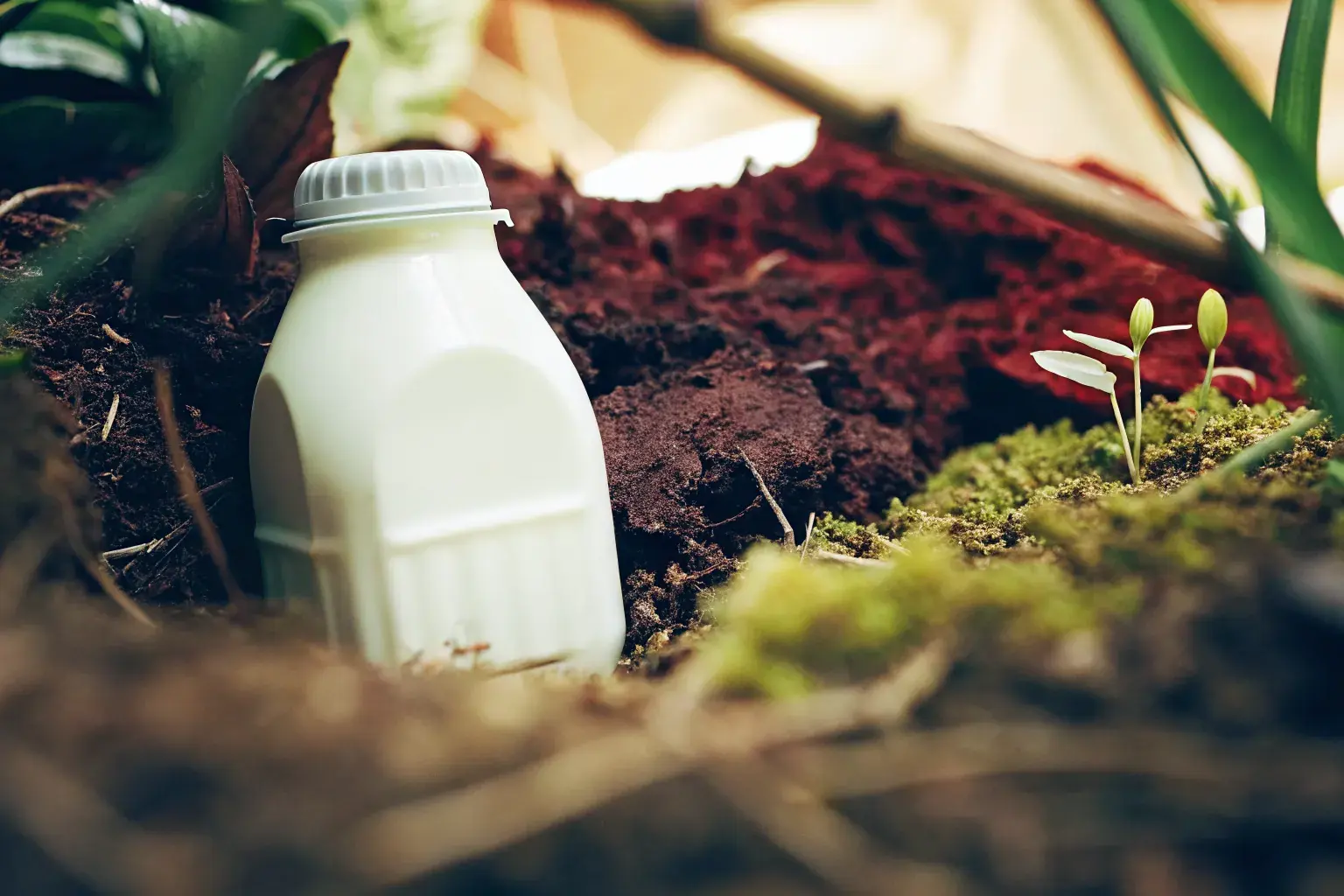
PHA Milk & Juice Jugs vs. Conventional HDPE: A Direct Comparison
The case for PHA becomes clearest when placed directly alongside the HDPE jugs that have dominated dairy and beverage packaging for decades. HDPE earned its position because it was the best available option. PHA preserves every functional advantage HDPE was chosen for — while delivering an end-of-life profile that HDPE can never match.
Conventional HDPE Milk & Juice Jugs
Strength
Low cost, established supply chains, dimensional precision, refrigeration performance, food-contact compliance.
Limitation
500+ years to fragment in the environment. Generates microplastics. Derived entirely from petroleum. Less than 30% recycling rate due to dairy contamination. No biodegradability under any conditions.
Best For
Legacy applications where end-of-life environmental impact is not a brand, regulatory, or consumer consideration.
PHA Milk & Juice Jugs
Strength
Full biodegradation in soil, marine, freshwater, home compost, and industrial compost. Zero microplastics. Petroleum-free. BPA-free. Drop-in manufacturing compatibility.
Limitation
Higher material cost than HDPE — offset by regulatory future-proofing, sustainability reporting value, and growing consumer demand for verified eco-packaging.
Best For
Any dairy brand, juice producer, or beverage company committed to sustainable packaging without functional compromise.
The Business Case for Dairy Brands and Juice Producers
Dairy brands and juice producers occupy a unique position in the sustainability conversation. They are among the largest distributors of single-use plastic containers in the food and beverage industry, and they serve end consumers — families, health-conscious shoppers, institutional buyers — who are increasingly making purchasing decisions based on packaging sustainability. The decision to adopt PHA jugs is not only an environmental commitment. It is a competitive positioning decision.
Sustainability reporting has become a baseline expectation from institutional investors, grocery retail procurement teams, and foodservice operators. Brands that can demonstrate material-level sustainability credentials — not recycled content percentages, not carbon offset certificates, but actual biodegradable packaging certified to biodegrade in marine and soil environments — are increasingly competitive in institutional supply relationships and premium retail channels. PHA provides that credential in tangible, verifiable form, backed by third-party certification.
Regulatory momentum makes the transition more urgent. Extended producer responsibility frameworks are advancing across U.S. states and international markets, placing the cost of plastic waste management onto the brands that produce and distribute it. Dairy companies that have already transitioned to biodegradable packaging before EPR mandates take effect will avoid compliance costs and position themselves as category leaders rather than compliance laggards scrambling to catch up.
"One billion HDPE jugs a year — that is what the dairy and juice industry puts into the environment. PHA gives brands a direct answer: the same jug, the same performance, and no environmental debt when it is done."
— Jim McGinnis, V.P. of Marketing & Sales, Pure Form Solution LLC
Pure Form Solution's PHA Milk & Juice Jug Line
Pure Form Solution's PHA milk and juice jug line covers the full range of beverage packaging needs — from one-gallon dairy jugs to half-gallon juice containers, quart and pint specialty formats, and bulk foodservice sizes. Every jug in the line is engineered as a drop-in replacement for its HDPE equivalent, manufactured from 100% plant-based PHA resin with no petroleum, no BPA, and no synthetic plasticizers.
Our jugs carry TÜV Austria certifications for OK compost Industrial, OK compost HOME, OK biodegradable MARINE, OK biodegradable SOIL, and OK biobased — the gold standard in independent biodegradability and biobased content verification. These are not marketing claims. They are third-party-verified performance standards that document exactly how, where, and within what timeframe our PHA packaging returns to nature.
For dairy brands and juice producers ready to make the transition, Pure Form Solution offers supply consultation, volume programs, and sustainability documentation to support your ESG reporting and regulatory compliance requirements. The switch starts with a sample and a conversation — and it ends with a packaging line that has no 500-year environmental debt attached to it.
The Jug That Ends the 500-Year Cycle
Every HDPE milk jug ever manufactured still exists somewhere on this planet. The one your family used last week will outlast every person alive today. Over one billion of them enter the environment annually, and none will ever fully disappear — only break down into progressively smaller particles that work their way up through the food chain and into our bodies.
PHA milk and juice jugs do not add to that accumulation. They perform the same function — protecting dairy and juice products through filling, cold chain distribution, retail display, and consumer use — and then return completely to the organic matter they were made from. No microplastics. No petroleum legacy. No environmental debt measured in centuries.
That is not a compromise. That is a better product. And the dairy and juice industry — which reaches more households, through more refrigerators, more frequently than almost any other sector of the food economy — is uniquely positioned to make that switch matter at scale.
Explore Pure Form Solution Products